Sponsored Adventure
Highline Adventures
California's longest zipline — 20 min from Solvang in the Santa Ynez Valley
Opens booking — Highline Adventures, Solvang
20 Fun Facts About Solvang
California's "Little Denmark" is stranger, more interesting, and more Danish than you might expect. From a secret windmill craftsman to the world's only authorized Little Mermaid replica — here's what makes Solvang genuinely unique.
1911
Founded
4
Windmills
287
Sunny days/yr
1M+
Annual visitors
Solvang was founded in January 1911 by Danish-American Lutheran immigrants from the Midwest.
Rev. Benedict Nordentoft, Rev. Jens M. Gregersen, and Prof. Peder P. Hornsyld — acting as the Danish-American Colony Corporation — purchased approximately 9,000 acres of Santa Ynez Valley ranchland for around $338,000 to establish a Danish colony with a folk high school and church.
"Solvang" is Danish for "sunny field" — sol (sun) + vang (field or meadow).
The founders picked the name to reflect both the California sunshine they found and the open agricultural land of the Santa Ynez Valley. After decades of cold midwestern winters, the climate felt like a revelation.
Solvang has about 6,000 residents — but attracts over one million visitors a year.
The 2020 census recorded 6,126 residents. Despite being smaller than most small towns, Solvang is among the most-visited communities in California. That's roughly 167 tourists for every resident.
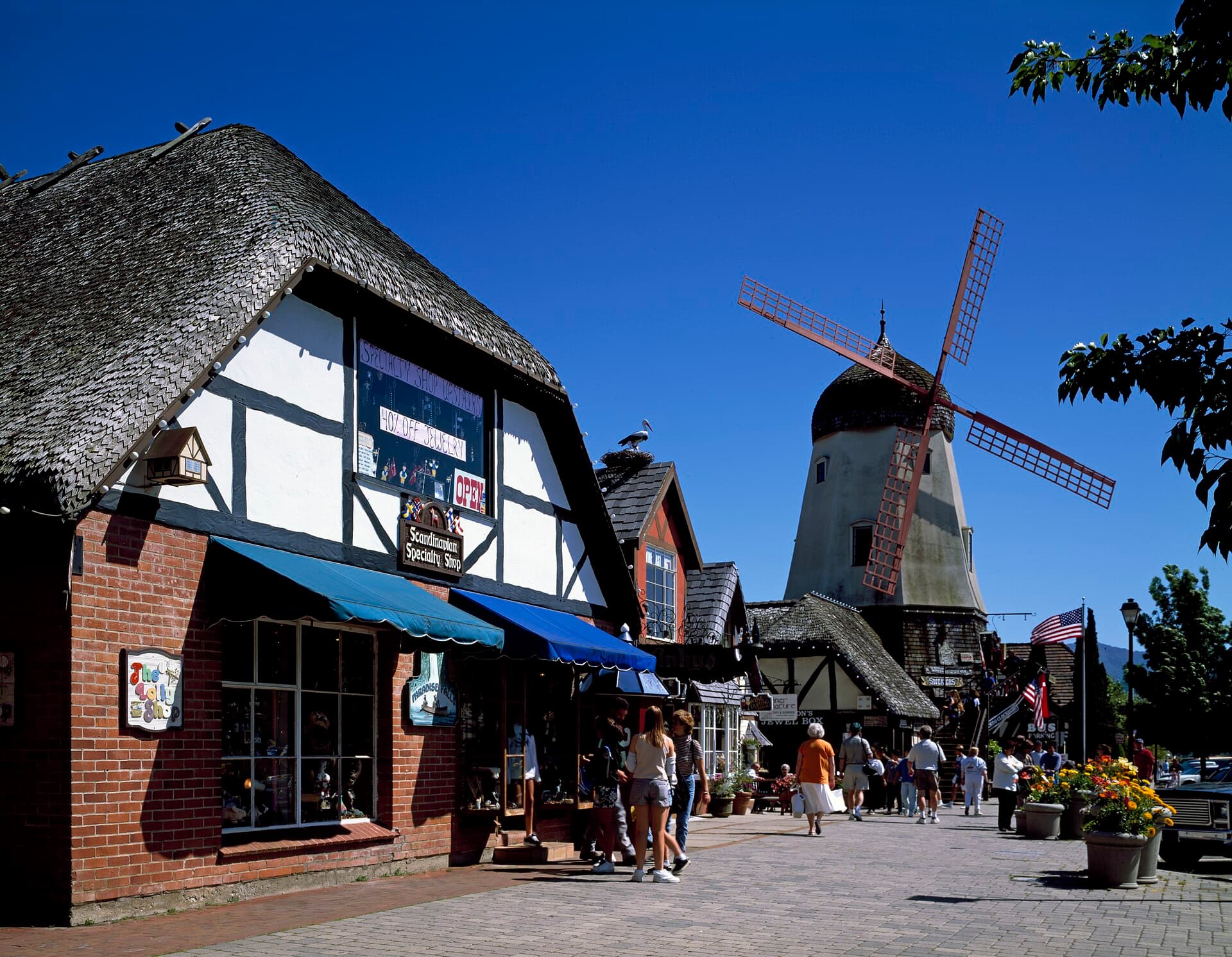
Downtown Solvang has exactly 4 windmills — all replicas of traditional Danish windmills.
They were built by Ferdinand Sorensen, a local plumber, metalsmith, and woodworker, after he returned from a visit to Denmark in the mid-1940s. None were part of the original 1911 colony.
Solvang has the only authorized half-size replica of Copenhagen's Little Mermaid statue in the world.
The bronze replica was installed in 1976 at the corner of Mission Drive and Alisal Road. It was approved by the heirs of original sculptor Edvard Eriksen — making it uniquely legitimate among the many unofficial copies that exist globally.
Solvang's Danish look was largely installed in the 1950s — not in 1911.
The half-timbered facades, copper stork sculptures, and windmills were added by local business owners after a 1947 magazine article triggered a tourism wave. The original Danish colony looked far more like a typical California farming town.
A single magazine article in 1947 transformed Solvang from a quiet farm community into a tourist destination.
"Little Denmark" by Dean Jennings, published January 18, 1947 in The Saturday Evening Post, described Solvang as a piece of Denmark in California. The article reached millions of readers and sent a wave of curious tourists to the Santa Ynez Valley.
The 2004 Oscar-winning film Sideways was filmed in and around Solvang.
Directed by Alexander Payne and starring Paul Giamatti and Thomas Haden Church, Sideways put Santa Barbara wine country on the map for a generation of wine lovers. It sparked the so-called 'Sideways effect,' dramatically increasing interest in Pinot Noir.
Danish royalty has visited Solvang multiple times — including Queen Margrethe II in 1976.
Danish Crown Prince Frederik and Princess Ingrid visited in 1939. Princess Margrethe first came in 1960. As queen, she returned in May 1976 with Prince Henrik. Prince Henrik came again in June 2011 to celebrate the town's 100th anniversary.
Danish Days — Solvang's annual heritage festival — has been running since 1936.
Created to celebrate the town's 25th anniversary, Danish Days is held each September and features street cooking of aebleskiver, folk dancing, and traditional Danish cultural exhibitions. It's one of the oldest ethnic heritage festivals in California.
Aebleskiver literally means "apple slices" in Danish — though there's rarely any apple in them.
These round, pancake-like balls of dough are cooked in a special cast-iron pan and served with powdered sugar and raspberry jam. They're the signature food of Solvang and sold year-round from several bakeries.
Mission Santa Inés — inside Solvang — was founded in 1804, over a century before the town itself.
Founded September 17, 1804, by Father Estévan Tapís, Mission Santa Inés was the 19th of 21 California missions. The mission farm originally occupied much of the Santa Ynez Valley floor and predates Solvang by 107 years.
Solvang has a Hans Christian Andersen Museum — dedicated to the Danish fairy-tale author who never visited California.
Located above the Book Loft at 1680 Mission Drive, the free museum houses hundreds of volumes of Andersen's works, many first editions, and items from his life. Solvang adopted HCA as its cultural patron despite no direct historical connection.
Solvang also has a one-third-scale replica of Copenhagen's 17th-century Rundetaarn (Round Tower).
Completed in 1991, the replica now houses Tower Pizza Restaurant. The original Rundetaarn was built in the 1640s as an astronomical observatory — still standing in central Copenhagen.
Solvang averages about 287 sunny days per year — making "sunny field" an apt name.
The mild Mediterranean climate, sheltered from marine fog by the Santa Ynez Mountains, was a major draw for the Danish founders. Coming from Minnesota and Iowa winters, the California sunshine must have felt extraordinary.
Solvang didn't become an official city until May 1, 1985 — 74 years after it was founded.
For most of its existence, Solvang was an unincorporated community governed by Santa Barbara County. It finally incorporated with a population of roughly 4,000.
Horse-drawn trolley tours of Solvang have been running since 1973.
The Solvang Trolley is a replica 1915 Honen trolley pulled by Belgian draft horses. The 25-minute narrated tour seats 20 riders and covers the main historical sites in the village.
Solvang was founded specifically to build a Danish folk high school — a uniquely Danish educational institution.
The Atterdag Folk School (later Atterdag College) opened November 15, 1911 with 21 students. It focused on Danish language, history, and literature. The school operated until 1937 — after which the tourism economy had replaced education as the town's economic engine.
One of Solvang's bakers previously baked for Queen Margrethe II of Denmark.
The Danish Mill Bakery is owned by Henrik Gram, who worked in a Copenhagen bakery that supplied the Danish royal household before he moved to Solvang. The royal connection to the California village goes both ways.
Only about 10% of current Solvang residents claim Danish ancestry — yet Danish identity remains the town's defining force.
A testament to the founders' vision: the architecture, festivals, bakeries, and cultural institutions they created have outlasted the ethnic demographic that built them by decades. Solvang is perhaps America's most successful example of a constructed ethnic identity.
Go deeper
These facts only scratch the surface. The full founding story — the Midwest ministers, the land deal, the folk school, and the post-WWII tourism transformation — is covered in detail on the history page.
Read the full history of Solvang →Solvang Trivia Quiz
10 questions — how well do you know California's Danish village?
What does "Solvang" mean in Danish?
More Solvang Guides
Full History of Solvang
The complete founding story, timeline, and where to see history today
Self-Guided Walking Tour
Visit the windmills, museums, and mission in order
Danish Days Festival
Annual September celebration — biggest event of the year
Things to Do in Solvang
Beyond history — wine tasting, food, and more