History of Solvang
Solvang was founded in 1911 by Danish-American Lutheran immigrants who bought 9,000 acres of California ranchland to build a Danish colony — complete with a folk high school and Lutheran church. More than a century later, the same mission church still holds services and the same festival still celebrates Danish heritage every September.
1911
Founded
"Sunny field"
Name means
Danish Lutheran immigrants
By
~6,000
Population today
The Founding of Solvang
In the early 1900s, Danish-American Lutheran communities in the Midwest were thriving but facing a challenge: younger generations were losing their connection to Danish language and culture. Danish folk high schools — a distinctly Danish educational tradition focused on adult learning, civic life, and cultural identity — were the solution leaders had in mind.
Rev. Benedict Nordentoft, Rev. Jens M. Gregersen, and Prof. Peder P. Hornsyld — Danish Lutheran ministers and educators from the Midwest — began looking for land in California where the climate was mild, property was affordable, and there was enough distance from urban centers to establish a genuine colony. In 1910, they found what they were looking for in the Santa Ynez Valley, then largely undeveloped ranchland in Santa Barbara County.
In January 1911, the group — acting as the Danish-American Colony Corporation — purchased approximately 9,000 acres of the former Rancho San Carlos de Jonata from the Santa Barbara Land and Water Company for around $338,000. They named the new community "Solvang" — Danish for "sunny field" — and subdivided the land into farm parcels and town lots. Within a year, the first Danish families had arrived from Iowa, Minnesota, and Wisconsin. The Atterdag Folk School opened in 1912, and the Bethania Lutheran Church held its first services the same year.
For the first three decades, Solvang was simply a Danish-American farming community — insular, quiet, and largely unknown outside its immediate region. The Danish language was spoken widely. Children attended the folk school. Families farmed the valley floor and raised cattle in the surrounding hills.
Timeline
Old Mission Santa Inés founded
Spanish Franciscan missionaries establish the 19th California mission on what will become the eastern edge of modern Solvang. The mission farm occupies much of the Santa Ynez Valley floor.
Mexican and American rancho era
After California statehood in 1850, Spanish land grants are converted to American ownership. The Santa Ynez Valley is divided into large cattle and sheep ranches. Small farming communities appear around Ballard (1880) and Los Olivos (1887).
Solvang is founded
In January 1911, a group led by Rev. Benedict Nordentoft, Rev. Jens M. Gregersen, and Prof. Peder P. Hornsyld — Danish Lutheran ministers and educators from the Midwest — purchases approximately 9,000 acres of the former Rancho San Carlos de Jonata from the Santa Barbara Land and Water Company for around $338,000. They form the Danish-American Colony Corporation, name the settlement "Solvang" (sunny field), and begin selling lots to Danish-American families, primarily from Iowa, Wisconsin, and Minnesota.
Atterdag College opens
The founding purpose of the colony was to establish a Danish folk high school — the Atterdag Folk School (later Atterdag College), named after the Danish king Valdemar Atterdag. The school taught Danish language, literature, history, and traditional Danish subjects to adult students. It operated until 1937.
Bethania Lutheran Church established
The community's religious center, Bethania Lutheran Church, is established — still an active congregation today at 603 Atterdag Road. The first services were held in Danish. The current building dates from 1928.
The farming town era
Solvang grows as a quiet farming and education community. The population is predominantly Danish-American, Danish is still spoken widely, and the town retains more of a colony than a tourist character. It remains unincorporated — governed by Santa Barbara County — until 1985.
Danish Days founded
The community begins holding Danish Days, an annual September celebration of Danish heritage with folk dancing, traditional foods, and cultural exhibitions. The festival — one of the oldest cultural festivals in California — continues today as the town's biggest annual event.
Saturday Evening Post article changes everything
On January 18, 1947, journalist Dean Jennings publishes "Little Denmark" in The Saturday Evening Post, describing Solvang as a hidden Danish colony in California. The article reaches millions of readers and triggers a wave of curiosity-driven tourism. Within a few years, local business owners begin rebuilding and styling storefronts to look more visibly Danish.
Danish architectural style adopted
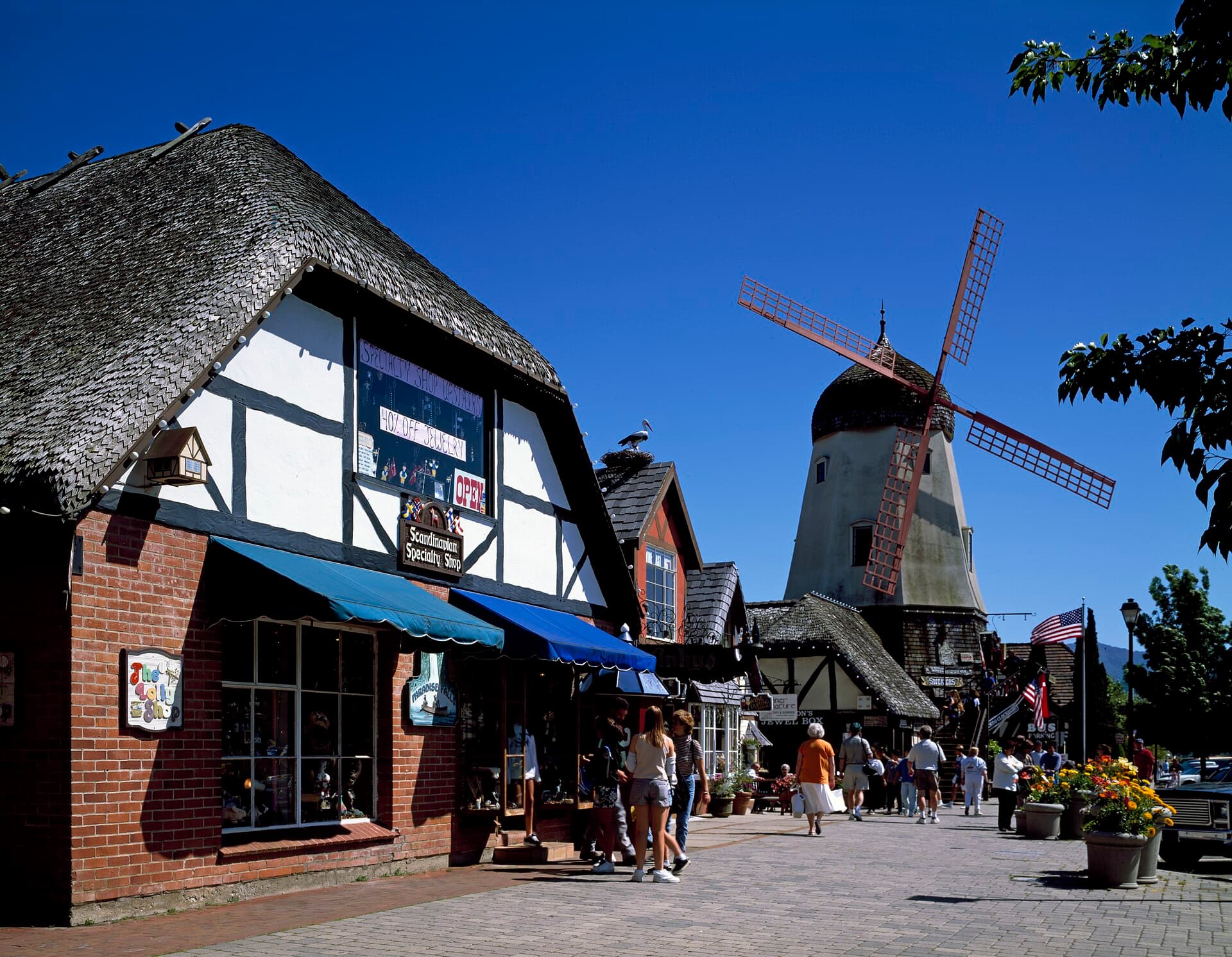
Business owners, recognizing tourism as an economic engine, begin adding half-timbered facades, copper stork sculptures, thatched roof accents, and miniature windmills to their buildings. The architectural character most visitors recognize today was largely installed in this decade.
Wine country development begins
Early vineyards are planted in the Santa Ynez Valley, initially for table grapes and bulk wine. The cool marine influence from the Pacific, channeled through Gaviota Pass and the Santa Ynez Mountains, proves well-suited to Burgundian varieties. By the late 1970s, quality wine estates are emerging.
Solvang incorporates as a city
After decades as an unincorporated community under Santa Barbara County, Solvang votes to incorporate as an independent city. The city covers about 2 square miles, with a population of roughly 4,000 at incorporation.
Sideways filmed in the valley
The Oscar-winning film Sideways is shot largely in the Santa Ynez Valley, including scenes in Solvang, Los Olivos, and Buellton. The film's portrayal of Pinot Noir and Santa Barbara wine country triggers a lasting surge in wine tourism to the region.
Danish heritage capital of California
Solvang is home to approximately 6,000 residents and hosts over one million visitors annually. The town maintains its Danish identity through architecture, the annual Danish Days festival, bakeries, and cultural institutions — while also serving as a gateway to one of California's premier wine regions.
Where to See Solvang History Today
Elverhøj Museum of History and Art
1624 Elverhøj Way, Solvang
The primary institution for Solvang and Santa Ynez Valley history. Permanent collection covers the Danish colony's founding; rotating art exhibitions feature regional artists. The adjacent Petersen House is a preserved early Danish homestead. Open Wed–Sun, $5 admission.
Old Mission Santa Inés
1760 Mission Dr, Solvang
Founded 1804 — predates Solvang by over a century. An active parish with a museum of mission-era vestments, paintings, and artifacts. The courtyard and campanario (bell wall) are largely unchanged. Open daily, $4 museum admission.
Bethania Lutheran Church
603 Atterdag Rd, Solvang
The founding congregation of the Danish colony, established 1912. The current building dates from 1928. Still an active Lutheran parish holding services in English (and occasionally Danish during Danish Days).
Hans Christian Andersen Museum
1680 Mission Dr (above Book Loft)
Free small museum dedicated to the Danish fairy-tale author — not a Solvang founder, but central to the town's Danish identity. Exhibits on HCA's life, manuscripts, and fairy tales. 20–30 minute visit.